
Washing machine capacity is the volume of the washer drum, measured in cubic feet (cu. ft.). Most home washers range from 1.5 to 6 cu. ft. The right capacity depends on three things: how many people live in your home, the largest items you wash, and how you load the drum. Our technicians repair washers across Bridgeport and Fairfield County every week, and many breakdowns start with a load that was too big for the drum. Follow these five steps to choose the right size and keep your washer running.
Step 1: Understand What Washer Capacity Measures
Capacity is the space inside the drum, not the cabinet size. Two washers with the same 27-inch width can hold different amounts of laundry because their drums are built differently.
- Front-load washers have no center post, so the full drum holds laundry.
- Top-load washers with an agitator give up part of the drum to the agitator post.
- Top-load washers with an impeller use a low plate instead of a post, which frees up more room.
US brands list capacity in cubic feet. European and UK brands list it in kilograms of dry laundry, with 8 to 9 kg as standard.
Step 2: Find Your Current Washer’s Capacity
Find your washer’s rated capacity in one of three ways:
- Check the owner’s manual or the spec sheet on the brand’s website.
- Look up the model number. It is printed on a label under the lid, around the door frame or on the back panel.
- Measure the drum. Measure its width and depth in inches, then use this formula: capacity (cu. ft.) = 3.14 × radius × radius × depth ÷ 1,728. A drum 22 inches wide and 14 inches deep holds about 3.1 cu. ft.
Step 3: Match the Capacity to Your Household
Washers fall into three capacity classes. Use this chart to match the class to your household.
| Capacity class | Cubic feet | Household size | Load per cycle |
|---|---|---|---|
| Small | 1.5–3.4 | 1–2 people | Up to 9 bath towels (1–2 baskets) |
| Medium | 3.5–4.4 | 2–3 people | 9–15 bath towels (2–3 baskets) |
| Large | 4.5 and up | 3+ people | 11–21 bath towels (3+ baskets) |
Choose a large capacity washer if any of these apply:
- More than three people live in your home.
- Your children play sports and bring home muddy uniforms.
- You run more than seven loads a week.
- You want fewer, bigger loads instead of daily laundry.
Step 4: Plan for Bulky Items
Comforters and duvets need room to move through the water, not just to fit. A medium washer handles queen bedding. A king-size comforter needs at least 4.5 cu. ft., and a thick down comforter cleans best in a 5.0 cu. ft. drum or larger. Wash bulky items alone so the drum stays balanced.
Your dryer should be larger than your washer, because wet clothes need room to tumble. Pair a large capacity washer with a dryer of 7 cu. ft. or more.
Step 5: Load the Drum the Right Way
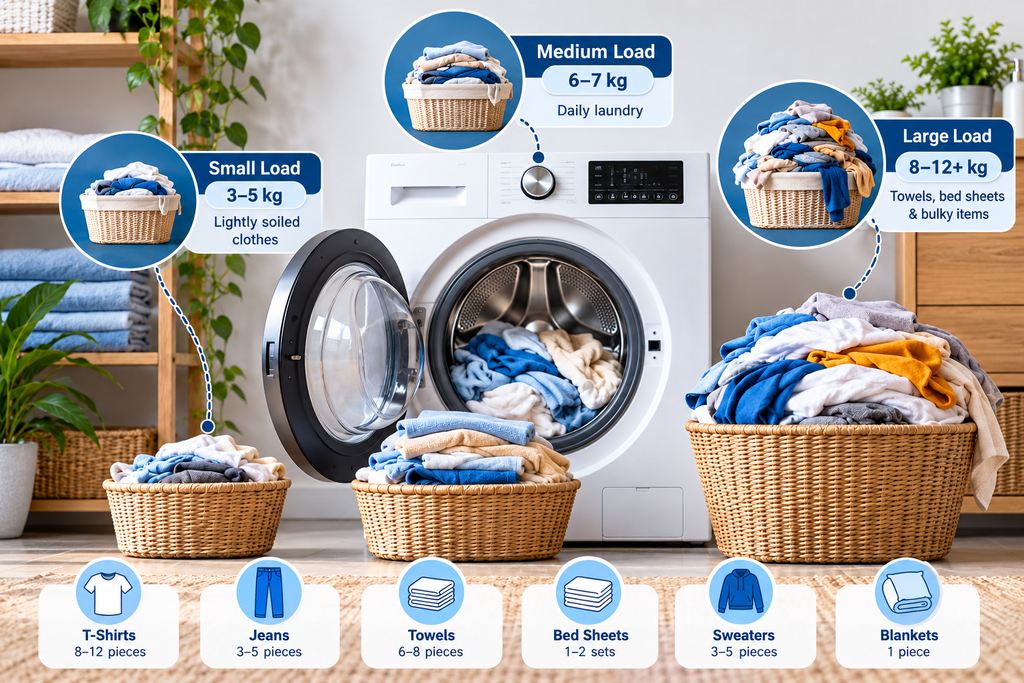
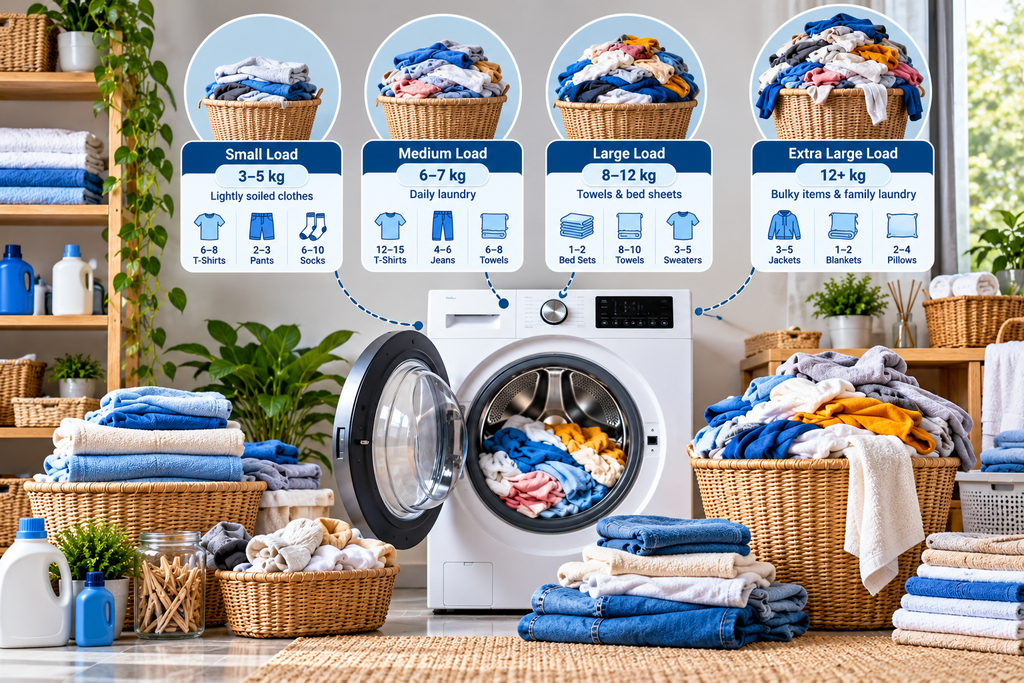
A washer’s capacity is a limit, not a target. Fill the drum half to three-quarters full with loose clothes, never packed tight. One armload is a medium load and two full armloads are a large load; if it takes two trips, split it into two loads. High-efficiency washers are the easiest to overload.
- Use the hand test. You should fit a flat hand between the top of the laundry and the top of the drum.
- Spread the load evenly around the drum, especially in a top-load washer.
- Mix large and small items so heavy pieces do not clump on one side.
- Use HE detergent in high-efficiency washers, in the amount the label lists for your load size.
What Overloading Does to Your Washer
An overloaded drum cleans poorly because water and detergent cannot circulate. Clothes come out dirty, smelly or streaked with detergent residue. Packed or uneven loads also throw the drum off balance during the spin cycle.
Repeated overloading wears out the parts that hold and turn the drum: shock absorbers, suspension rods, drum bearings, the drive belt, and the motor. These are some of the most common washer repairs we see. Watch for these warning signs:
- The washer shakes, bangs, or “walks” across the floor on the spin cycle.
- You hear grinding or a loud rumble while the drum turns.
- The display shows an unbalanced-load error code.
- Clothes come out soaking wet, or water stays in the drum after the cycle.
Water left in the drum points to a drain problem; see our guide to a washing machine not draining.
When to Call a Washer Repair Technician
If your washer still shakes, grinds, or leaves clothes wet with a correctly sized load, a part is likely worn. Continuing to run it can turn a simple shock absorber replacement into a bearing or motor repair.
Service King LLC provides washing machine repair for all major brands, including LG, Samsung, Whirlpool, Maytag, GE, Bosch, Electrolux, and Frigidaire. Our certified technicians offer same-day appointments, upfront quotes before any work begins, and a warranty on every repair. Call 203-904-8850 or request a service visit for appliance repair in Bridgeport, CT, and nearby Fairfield County towns.
Washing Machine Capacity FAQs
What is the standard washing machine capacity? Most standard washers hold 3.5 to 5 cu. ft., which covers everyday laundry and occasional large loads.
Is a 4.5 cu. ft. washer considered large? Yes. Large capacity washers start at 4.5 cu. ft. and handle bulky bedding and family-size loads.
What size washer does a family of four need? A family of four does best with a 4.5 cu. ft. washer or larger. A 4.0 to 4.4 cu. ft. washer works if you do laundry several times a week and rarely wash king bedding.
How do you know if a load is too big? Clothes come out dirty, smelly or with detergent residue, or the washer shakes hard on spin. Split the load in two.