
An ice maker not making ice usually points to one of three problems: no water reaches the mold, water reaches the mold but does not freeze, or ice forms but does not drop into the bin. Each problem has different causes, so a quick diagnosis saves you time and money. This guide walks you through the checks in the right order, from simple settings to deeper component faults, so you know what to fix yourself and when to call a technician.
Start Here: Which Problem Do You Have?
Identify your symptom first. It tells you where to look.
| What you notice | Most relevant areas |
|---|---|
| Ice maker is completely inactive | Power, switch, shutoff arm |
| Ice tray stays empty | Water supply, filter, fill tube, inlet valve |
| Water dispenser works, but the ice tray stays empty | Ice maker fill path, fill tube, inlet valve, freezer temperature |
| Water enters the mold but does not freeze | Freezer temperature, cooling problem |
| Ice freezes but stays in the mold | Ejector, harvest motor, jam |
| Ice production is very slow | Freezer temperature, filter, water flow |
| Problem began after a filter change | Filter installation |
| Problem began after a new refrigerator installation | Cooling time, water line, trapped air |
| Problem began after plumbing work | Household shutoff valve |
| Food in the freezer also feels warm | Broader refrigerator cooling issue |
How an Ice Maker Works
Every ice maker follows the same chain of events:
Freezer reaches temperature → inlet valve opens → fill tube delivers water → water freezes in the ice mold → harvest cycle releases the cubes → ice drops into the bin
A failure at any step stops ice production. That is why a good diagnosis follows the whole chain instead of replacing the first part you suspect.
New Refrigerator Not Making Ice Yet?
Give it time. A newly installed refrigerator may need up to about 24 hours to get cold enough to start its first ice cycle. The first few batches may also be small. If more than a day passes and the tray stays empty, continue with the checks below.
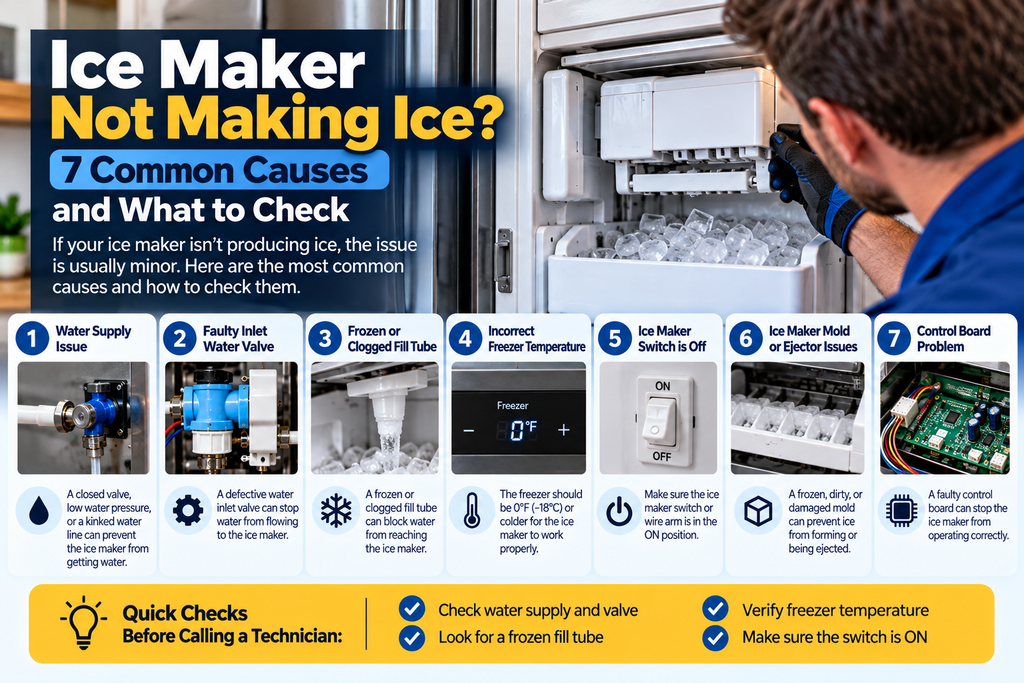
1. The Ice Maker Is Turned Off
This is the easiest check, and it needs no tools.
- Check the control panel. Many models let you turn the ice maker on or off from a display or button.
- Check the switch. Some models use a physical on/off switch on the ice maker.
- Check the shutoff arm. On models with a wire arm above the bin, a raised arm tells the ice maker to stop. Lower the arm to the down position.
The arm or an infrared sensor is also what tells the machine to stop making ice. When the bin fills and the cubes lift the arm, or block the sensor, the ice maker pauses on purpose.
2. The Water Supply Is Shut Off or Restricted
Water has to reach the refrigerator before the ice maker can fill. Check these points first:
- Make sure the water line is connected to the refrigerator.
- Open the household shutoff valve fully. Look behind the refrigerator or under the sink.
- Check the tubing for kinks, pinches, or crushing.
Before you replace an ice maker, confirm that water can actually reach it. People often replace parts when someone simply turned off the supply valve and never reopened it. This happens most often after plumbing work, a move, or a refrigerator relocation.
3. The Water Filter Is Clogged or Installed Incorrectly
A restricted filter reduces water flow. Less water means the mold fills poorly, and you get little or no ice.
Clogged filter → reduced water flow → ice mold does not fill properly → little or no ice
What to do:
- Replace the filter if it is older than about six months, or follow the schedule in your owner’s manual.
- Use a manufacturer-approved filter. Generic filters can restrict flow.
- Confirm that the filter sits fully in its housing and locks into place.
Did the problem start right after a filter change? Check the filter installation first.
4. The Freezer Is Too Warm
Temperature is one of the biggest factors in ice production. The ice maker must get cold enough before it starts a cycle, and the freezer needs to stay between 0°F and 5°F, ideally at 0°F.
Freezer temperature → ice maker sensor or thermostat → harvest cycle
Is the Ice Maker Broken, or Is the Freezer Too Warm?
Put a thermometer in the freezer and check the reading. Then look for other signs of a cooling problem:
- Frozen food feels soft or partly thawed.
- Ice cream will not stay solid.
- Frost builds up in unusual places.
- The freezer cannot get below about 20°F, even after you lower the setting.
If the freezer is too warm, replacing the ice maker will not fix the problem. The cause may be a failed fan, a blocked airflow path, or a deeper cooling system fault. A technician can diagnose refrigerator cooling problems before you spend money on the wrong part.
5. The Fill Tube Is Frozen
The fill tube carries water into the ice mold. If ice blocks it, water cannot reach the mold, and the tray stays empty.
Frozen fill tube → water cannot reach the mold → empty ice tray → no ice
You can thaw the tube carefully with a hair dryer on low heat. Keep the heat moderate and the dryer moving so you do not melt plastic parts.
Then ask why it froze. If the tube freezes again, look for an underlying cause, such as low water pressure, a restricted filter, a leaking inlet valve, or a freezer temperature problem. Thawing the tube treats the symptom but leaves the cause in place.
6. The Water Inlet Valve Has Failed
The inlet valve is an electrically controlled valve that opens when the ice maker asks for water.
Ice maker requests water → inlet valve opens → fill tube delivers water → ice mold fills
A failing valve may open only partly, stay closed, or leak. Signs include an empty mold, a tube that keeps freezing, or a slow trickle of water. Check the simpler causes first (supply valve, filter, fill tube), because those are more common and cheaper to fix.
A technician can test the valve with
a meter. Replacing it involves water and electrical connections, so professional help is the safer choice.
Water Dispenser Works but the Ice Maker Does Not
This is one of the most common symptoms, and it can confuse people. A working dispenser proves that water reaches the refrigerator. It does not prove that water reaches the ice maker.
If the dispenser works and the tray is empty, check these causes next:
- The ice maker is turned off or the arm is raised.
- The fill tube is frozen.
- The filter restricts flow to the ice maker.
- The ice maker side of the inlet valve has failed.
- The freezer is too warm for the ice maker to start a cycle.
- A jam or faulty assembly prevents the harvest cycle.
Start with the free checks (switch, arm, fill tube) and move toward the valve and assembly.
7. Ice Is Jammed or Will Not Eject
Sometimes the ice maker makes ice but does not release it. A stuck cube can stop the ejector rake before it finishes the cycle, and clumped ice can jam the harvest mechanism.
What to check:
- Remove the ice bin.
- Look for frozen clumps, an ice bridge, or cubes lodged near the ejector fingers or sensor.
- Remove stuck ice and discard the clumped batch.
- Dry the area and replace the bin.
If ice jams again, the freezer may be too warm, or moisture may be entering the bin. If the ejector does not move at all, a faulty harvest motor or ice maker assembly is likely.
8. The Ice Maker Module, Motor, or Wiring Has Failed
Deeper electrical faults come last. They include the ice maker module, harvest motor, relay, wiring harness, or control board.
Diagnose the simple water and temperature path before you replace electronic controls.
Control parts are often expensive, and they are rarely the first cause. Check the switch, water supply, filter, fill tube, temperature, and jams first. If all of them check out, schedule a professional ice maker repair service so a technician can test the module, motor, and wiring before replacing parts.
Can You Reset an Ice Maker?
Yes, in many cases. Reset steps vary by brand and model, so check your owner’s manual first. Common methods include:
- Turning the ice maker off, waiting a few minutes, and turning it back on.
- Using a reset or test button, if your model has one.
- Switching the refrigerator’s breaker off for a few minutes, then turning it back on.
Does Unplugging the Refrigerator Reset the Ice Maker?
Often it does, because cutting power clears many electronic faults. Keep the doors closed while the power is off to protect your food, and expect the first ice to take several hours.
When to Call a Professional
Call a technician if:
- You checked the switch, supply, filter, fill tube, and temperature, and the problem remains.
- The freezer stays warm even at the correct setting.
- The fill tube keeps freezing.
- The ejector does not move.
- You see leaks or hear unusual noises.
Service King offers refrigerator and freezer repair that follows the whole ice-making chain, so you pay to fix the real cause. If you want a clear answer, book a professional ice maker diagnosis.
Also see our guide on an ice maker leaking water, because the fill tube, inlet valve, and filter overlap with the causes above.
How to Keep Your Ice Maker Working
- Replace the water filter on schedule.
- Keep the freezer at 0°F.
- Do not overload the freezer, which blocks airflow.
- Check the supply line after any plumbing or moving work.
- Remove old, clumped ice and wipe the bin regularly.
- Close the freezer door fully so warm air and moisture stay out.
Frequently Asked Questions
Why is my ice maker not making ice?
The most common causes are a switched-off ice maker, a shut-off or restricted water supply, a clogged filter, a freezer that is too warm, a frozen fill tube, or a jam. Check them in that order.
Why is my ice maker not filling with water?
The supply valve may be closed, the line may be kinked, the filter may be clogged, the fill tube may be frozen, or the inlet valve may have failed.
Why does my water dispenser work but my ice maker does not?
A working dispenser shows that water reaches the refrigerator, but the ice maker has its own fill path. The ice maker may be off, the fill tube may be frozen, the freezer may be too warm, or the inlet valve may have a fault.
Can a clogged water filter stop an ice maker from working?
Yes. A clogged or incorrectly installed filter reduces water flow, so the mold fills poorly and produces little or no ice.
What temperature should the freezer be for the ice maker to work?
Keep the freezer between 0°F and 5°F, ideally at 0°F.
Why does my ice maker make ice but not dump it?
A stuck cube, clumped ice, or a jammed ejector can stop the harvest cycle. A failed harvest motor or ice maker assembly can also cause it.
How do I know if the water inlet valve is bad?
Signs include an empty mold, a fill tube that keeps freezing, a very slow trickle of water, or leaks near the valve. A technician can confirm the fault with a meter.