
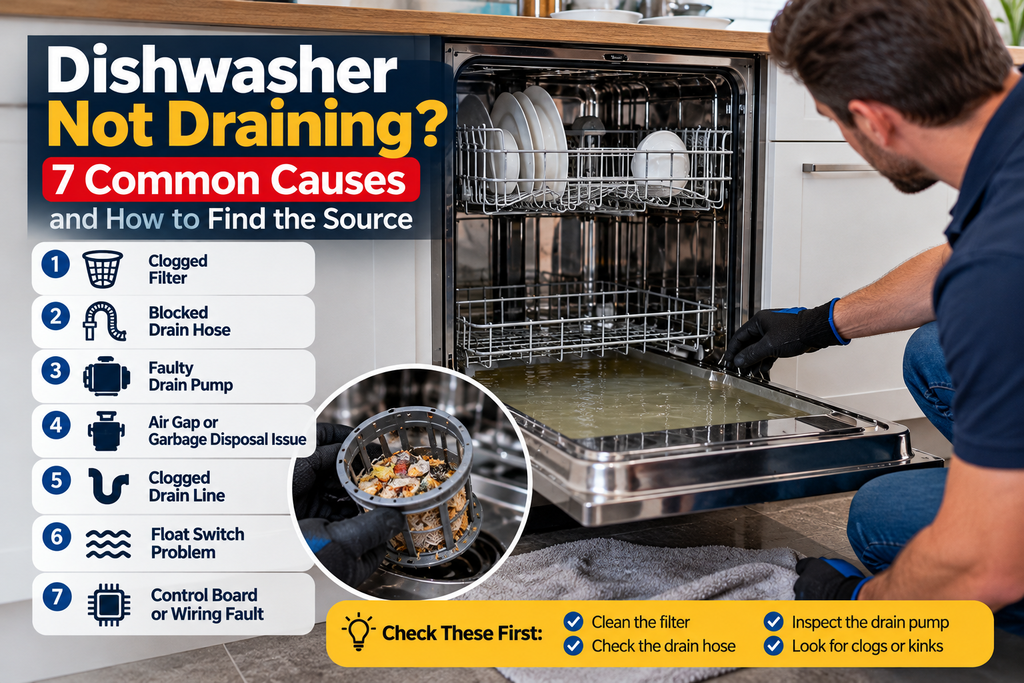
A dishwasher not draining leaves you with a tub of dirty water, a bad smell, and a pile of dishes you cannot trust. The good news is that most drainage problems start with something simple, such as a clogged filter, a kinked hose, or a blocked garbage disposal connection. This guide walks you through the full drain path, from the tub to the household plumbing, so you can find the cause in a logical order and know when to call a professional.
Before You Start: Safety First
Follow these steps before you touch anything inside the dishwasher:
- Turn off the power. Unplug the dishwasher or switch off its circuit breaker.
- Remove the standing water. Scoop it out with a cup and bowl, or use a wet/dry vacuum, so you can reach the drain area.
- Watch for sharp debris. Broken glass and plastic pieces often collect near the drain. Wear gloves and look carefully before you reach in.
- Check your owner’s manual. Filter designs differ by model, and some dishwashers have no removable filter at all.
How Does a Dishwasher Drain?
Water follows one path every time the machine drains:
Tub → filter → sump → drain pump → drain hose → high loop or air gap → garbage disposal or sink drain → household plumbing
A blockage, kink, or failure anywhere along this path leaves water in the tub. That is why a good diagnosis checks the whole path instead of assuming the pump is bad.
Quick Diagnosis Table
Use this table to jump to the most likely cause.
| What you notice | Most relevant areas |
|---|---|
| Water remains after every cycle | Filter, pump, drain hose |
| Dishwasher hums but will not drain | Pump impeller, blockage |
| Grinding noise during drain | Debris near the pump |
| Silent during drain | Pump motor, wiring, control |
| Problem started after a new garbage disposal | Knockout plug |
| Problem started after dishwasher installation | Pinched hose, high loop, air gap |
| Water drains, then returns | High loop, air gap, check valve, sink drain |
| Sink also drains slowly | Household plumbing |
| Water comes out of the air gap | Restriction downstream |
| Only a small amount of water in the sump | May be normal on some models |
Is a Dishwasher Supposed to Drain Completely?
On some models, a small amount of water stays in the sump after the cycle ends. That is normal. A visible pool of water that covers the bottom of the tub, or water that sits above the filter, is not normal and points to a drainage problem.
Also note what the water looks like. If the water is dirty and smells, food debris is probably trapping it. If the dishwasher drains and then dirty water returns, the problem lies in the backflow path, not in the pump.
1. The Dishwasher Filter or Sump Is Clogged
Why it happens: Food debris, grease, labels, popcorn kernels, and mineral buildup collect in the filter and sump. This restricts water flow, and the water stays in the tub.
What to check:
- Remove the bottom rack.
- Locate the filter near the base of the lower spray arm.
- Follow your owner’s manual to remove it. Many filters twist counterclockwise and lift out.
- Rinse the filter under warm water and scrub off grease with a soft brush.
- Look into the open sump for broken glass, seeds, or small objects.
- Reinstall the filter exactly as the manual shows.
Important: A filter that sits incorrectly can cause new drainage problems and error codes, so confirm that it locks into place.
2. The Drain Hose Is Kinked or Blocked
Why it happens: A bent, pinched, or crushed hose cannot carry water away. Sediment and food particles can also build up inside an older hose. Kinks often appear right after a new installation or a kitchen remodel, when the dishwasher sits on top of its own hose.
What to check:
- Look under the sink and follow the hose from the dishwasher to its connection.
- Straighten any kinks or bends.
- Make sure nothing, including the dishwasher itself, pinches the hose.
- If the hose is safe to disconnect, check the hose end and rubber connector for clogs.
If you find a cracked or damaged hose, replace it. Hose routing must also follow your local plumbing requirements.
3. The Garbage Disposal Is Blocking the Drain Path
Many dishwashers drain through the garbage disposal. If the disposal is clogged, the dishwasher has nowhere to send its water.
What to check:
- Run the disposal for 15 to 20 seconds with cold water to clear food buildup.
- Check the disposal inlet where the dishwasher drain hose connects.
- Confirm the sink and disposal drain normally on their own.
Dishwasher Not Draining After a New Garbage Disposal?
This is one of the most commonly missed causes. New disposals have a knockout plug inside the dishwasher inlet. If the installer did not remove it, the plug blocks the drain line completely, and no water can leave the dishwasher.
If your problem began right after a disposal installation, check the plug first. Turn off the power to the disposal, then follow the disposal manufacturer’s instructions to remove it. If you are not comfortable working under the sink, a technician can do it quickly.
4. The Air Gap or High Loop Has a Problem
Sometimes water leaves the dishwasher and then flows back in. A high loop (the drain hose routed high under the countertop) or an air gap (the small cap next to your faucet) stops dirty sink water from returning to the tub.
Signs of a problem:
- Water drains, then fills the tub again with dirty water.
- Water comes out of the air gap during the drain cycle. This often means a restriction downstream.
- The hose has no high loop and sits low under the sink.
What to check:
- If you have an air gap, lift off the cap and clear trapped food or grease with a bottle brush.
- Make sure the drain hose rises into a high loop before it connects to the disposal or sink drain.
- Confirm the setup matches your local requirements.
5. The Drain Pump or Impeller Is Jammed or Failed
The drain pump pushes water out of the tub. A small piece of broken glass or plastic can jam the impeller, and a worn motor can stop working altogether.
What Does the Drain Pump Sound Like?
Listen closely at the start of the drain cycle:
- Humming but no water movement: The pump receives power, but the impeller may be jammed or damaged.
- Grinding or rattling: Debris is probably interfering with the impeller.
- Complete silence: The pump motor may have failed, or it may not receive power from the wiring or control board.
Pump problems often need a technician. The pump sits in a tight space, and sharp debris makes the job risky. If the filter, hose, disposal, and air gap all check out, the pump is the next suspect.
6. The Sink Drain or Household Plumbing Is Clogged
Not every drainage problem comes from the appliance. Run water in the sink connected to your dishwasher.
- If the sink drains slowly or backs up, the clog is in the sink drain or household waste line. Fix the plumbing first. Replacing dishwasher parts will not help.
- If the sink drains normally, keep working through the other causes.
When the household drain is the problem, a plumber is usually the right call.
7. The Check Valve or Internal Drain System Has Failed
The check valve allows water to leave the tub but blocks it from returning. If the valve sticks in the wrong position, it can interfere with drainage or let water flow back in.
Check this cause last. It is less common than the six above, and you usually need a technician to inspect internal parts.
Dishwasher Showing an Error Code?
If your dishwasher displays a drain or overflow error, record the exact code and your model number before you reset the machine. Error code meanings vary by manufacturer, so a technician can diagnose the problem faster when you share both details.
Can You Force a Dishwasher to Drain?
You can help water leave the tub, but you cannot fix the underlying cause by forcing it. Safe options include:
- Scooping out the water by hand or with a wet/dry vacuum.
- Cleaning the filter and sump.
- Running the drain or cancel cycle once after clearing a blockage.
Avoid repeated cycle restarts. They waste water and can strain the pump.
What Can You Pour Down a Dishwasher to Unclog It?
A mix of baking soda and white vinegar can help with light grease and odors, but it will not clear a hard blockage such as a plug, a kinked hose, or a jammed impeller. Skip harsh chemical drain cleaners. They can damage rubber hoses and seals, and they are unsafe if water stays in the tub.
When to Call a Professional
Call a technician if:
- You cleaned the filter and checked the hose, disposal, and air gap, and water still stays in the tub.
- The pump hums, grinds, or stays silent.
- You find broken glass you cannot remove safely.
- A drain or overflow error keeps coming back.
- You see leaks, burning smells, or electrical problems.
Service King provides dishwasher repair services that cover drainage problems, from clogged lines to failed drain pumps. Our team follows the full drain path, so you pay to fix the real cause. If you want a clear diagnosis without guesswork, book professional dishwasher diagnosis with a local technician.
How to Prevent Drainage Problems
- Scrape plates and remove large food scraps before loading.
- Clean the filter every month, or more often if you cook with a lot of grease.
- Run the garbage disposal before you start a cycle.
- Keep broken glass, labels, and small objects out of the tub.
- Run hot water at the sink before starting the dishwasher.
- Schedule an appliance repair service visit if you notice slow draining, which often signals a problem before it gets worse.
Frequently Asked Questions
Why is my dishwasher not draining?
The most common causes are a clogged filter, a kinked or blocked drain hose, a blocked garbage disposal connection, a clogged air gap, or a jammed drain pump. Check them in that order.
Why is there water standing in the bottom of my dishwasher?
Standing water usually means food debris, a clog, or a kink is stopping water from leaving the tub. A small amount in the sump can be normal on some models, but a visible pool after the cycle ends is not.
How do I know if my dishwasher drain pump is bad?
Listen during the drain cycle. A humming pump with no water movement suggests a jammed impeller, grinding suggests debris, and silence suggests a failed motor or no power.
Can a garbage disposal cause a dishwasher not to drain?
Yes. Many dishwashers drain through the disposal, so a clogged disposal blocks the drain path.
Why did my dishwasher stop draining after a new garbage disposal was installed?
The installer may have left the knockout plug in the disposal’s dishwasher inlet. The plug seals the drain line completely until someone removes it.
Can a clogged sink drain stop a dishwasher from draining?
Yes. If the sink drain or household waste line is clogged, the dishwasher cannot discharge water. Run the sink to test it.
Why does my dishwasher drain and then fill back up with dirty water?
This points to backflow. A missing high loop, a clogged air gap, a faulty check valve, or a blocked sink drain can send water back into the tub.