An oven not heating does not always mean the entire appliance has failed. The clock may work, the oven light may turn on, or the control panel may respond even when the oven produces little or no heat.
The correct diagnosis depends heavily on whether you have a gas oven or an electric oven. Electric models rely on a heating circuit and elements, while gas models depend on an igniter, gas safety valve, burner, and gas supply.
Start with what you can actually observe before replacing any parts.
First, Identify What Your Oven Is Doing
Different symptoms point toward different parts of the heating system.
Nothing works at all: Start with the circuit breaker and power supply.
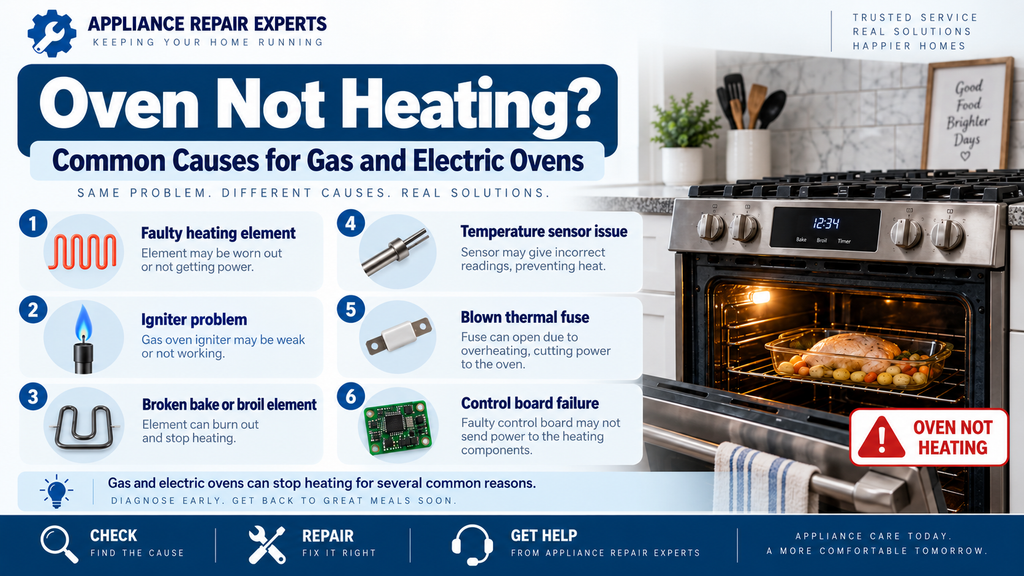
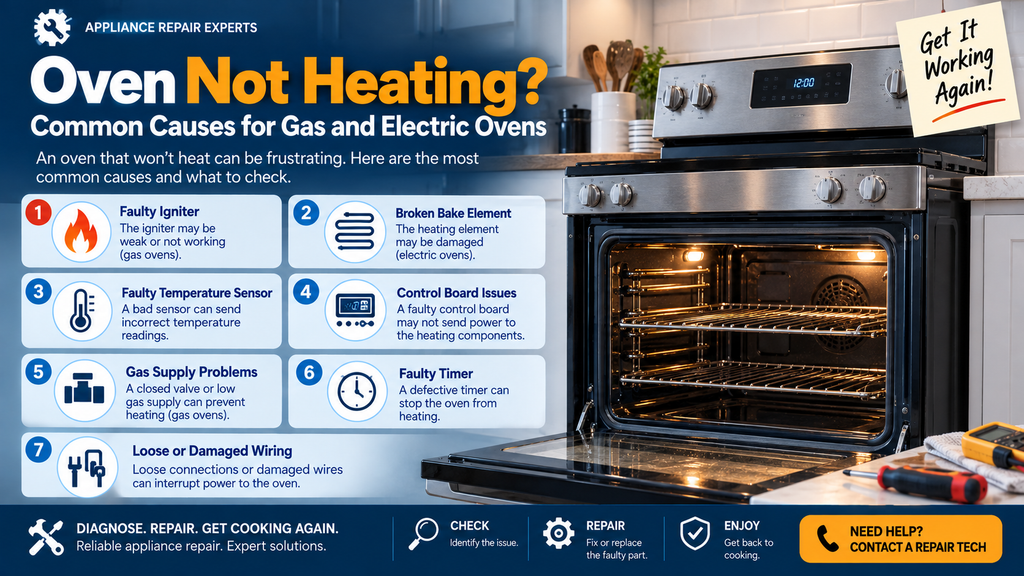
The display works but there is no heat: An electric oven may have a power, bake element, thermal fuse, or control problem.
Broil works but bake does not: Focus on the bake circuit and bake element.
A gas igniter glows but the burner does not light: The igniter may be too weak to operate the gas safety valve correctly.
The oven gets warm but never reaches temperature: Check the heating source, temperature sensor, door seal, calibration, and controls.
The problem started after a self-clean cycle: Thermal protection or a door latch-related issue may need attention.
Whirlpool also recommends ruling out conditions such as demo mode, delayed start, door position, and installation-related power problems before assuming that an internal component has failed.
Gas Oven Versus Electric Oven: Why the Difference Matters
A gas oven and an electric oven create heat differently.
In an electric oven, the relationship is:
Electrical supply → heating circuit → bake element → heat
In a gas oven, the relationship is:
Igniter → gas safety valve → burner → heat
Mixing these two diagnostic paths can lead homeowners toward the wrong component.
For an electric oven, start with power and the bake element. For a gas oven, check the gas supply and igniter before moving toward internal controls.
1. The Oven Is Not Getting the Correct Electrical Power
Power should be the first check, even when the oven display works.
An electric oven normally relies on a 240-volt electrical supply for its heating system. A problem with the breaker, connection, terminal block, or supply circuit can interfere with heating.
This creates a confusing symptom:
The clock works, but the oven does not heat.
The display or oven light working does not prove that the entire heating circuit is receiving the power it needs.
Whirlpool recommends checking the circuit breaker and electrical connection before moving into component diagnosis. It also notes that installation connections can affect oven operation.
You can safely check whether the breaker appears tripped and whether the control panel displays an error.
Do not perform live 240-volt testing unless you have the proper electrical training and equipment.
2. The Bake Element Has Failed in an Electric Oven
The bake element provides much of the heat used during the bake cycle in many electric ovens.
A failing element may stop heating completely, but failure can also develop gradually.
Look inside the oven after it has cooled and power has been disconnected.
Possible visible signs include:
• Blistering
• Cracks
• Burned areas
• Ruptures
• Warped sections
• An element that stays dark during heating
Whirlpool lists a heating element that does not glow as one possible sign of element failure. iFixit also recommends inspecting the element for blisters, cracks, or broken sections.
A real homeowner repair case showed how progressive this failure can be. The oven became less effective over several weeks until it only became warm even when set to 450°F. The bake element had visible bubbling and ruptured areas.
That is an important diagnostic lesson.
A heating element does not always fail instantly.
Does Broil Work but Bake Does Not?
Comparing the bake cycle with the broil cycle can provide a useful clue.
Many electric ovens use separate heat sources for baking and broiling.
If the upper broil element becomes hot but the oven barely heats during bake, the bake element or its circuit deserves closer attention.
This symptom is especially useful when the oven gets somewhat warm rather than remaining completely cold. Heat from the broil element may make the cavity feel warm even when the primary bake element has failed.
Do not assume the control board is bad before checking the separate heating circuits.
3. The Gas Oven Igniter Is Weak or Defective
The hot surface igniter is one of the most important components in a gas oven.
Its job involves more than simply creating heat.
The normal sequence is:
Igniter heats → gas safety valve opens → gas reaches burner → burner produces heat
Whirlpool identifies the gas igniter as a central component to inspect when a gas oven does not heat.
Igniter Glows but the Gas Oven Still Does Not Heat
This symptom causes a lot of confusion.
A glowing igniter does not automatically mean the igniter is good.
The igniter must draw enough current for the gas safety valve to open on common hot surface ignition systems. An aging igniter can glow while remaining too weak to complete that process. iFixit describes this exact relationship between igniter current and safety valve operation.
You may notice:
• Igniter glows, but no flame appears
• Very slow ignition
• Oven takes a long time to preheat
• Burner lights inconsistently
• Oven becomes warm but not hot enough
Determining whether the igniter or gas valve has failed may require electrical testing. Leave live gas valve and igniter circuit testing to a qualified technician.
If you smell or hear leaking gas, leave the home and contact local gas authorities from outside. Do not operate lights, phones, or other electrical equipment before leaving.
4. The Temperature Sensor or Thermostat Is Giving Incorrect Readings
An oven that produces no heat and an oven that does not reach the correct temperature are not always the same problem.
The temperature sensor monitors heat inside the oven cavity. The control system uses that information to decide when heating should continue or stop.
The relationship is:
Temperature sensor → control board → heating command → oven temperature
If the sensor gives incorrect information, the oven may stop heating too early or struggle to maintain the selected temperature.
Possible symptoms include:
• Oven takes too long to preheat
• Food consistently cooks too slowly
• Displayed temperature does not match actual temperature
• Oven heats but never becomes hot enough
• Temperature varies significantly during cooking
Whirlpool recommends checking the position of the temperature sensor when troubleshooting heating performance.
Could the Oven Simply Need Calibration?
Calibration is more relevant when the oven heats consistently but the actual temperature differs from the selected temperature.
It is less likely to explain an oven that produces absolutely no heat.
Check the owner’s manual for the correct calibration procedure before changing temperature offsets.
5. A Thermal Fuse or Safety Device Has Opened
Many ovens use protective components designed to interrupt operation when unsafe temperatures occur.
A thermal fuse or thermal safety device can open after an overheating event and interrupt the heating circuit.
The relationship is:
Overheating → thermal protection opens → heating circuit stops
This can sometimes occur after unusually high heat conditions, including problems associated with a self-clean cycle on applicable models.
The important point is that replacing a thermal fuse without finding out why it opened may not solve the underlying problem.
A cooling fan fault, overheating condition, wiring issue, or other component may also require diagnosis.
Testing a thermal fuse usually requires access to internal electrical components. This belongs closer to professional diagnosis than basic homeowner troubleshooting.
Did the Problem Start After a Self-Clean Cycle?
Pay attention to timing.
If the oven stopped heating immediately after a self-clean cycle, tell the technician.
Depending on the model, possible areas to investigate may include:
• Thermal protection
• Door latch
• Latch switch
• Electronic control
• Wiring affected by excessive heat
A self-clean-related failure is not the first explanation for every oven heating problem, but the timing can provide a valuable diagnostic clue.
6. The Gas Safety Valve or Gas Supply Has a Problem
A gas oven needs both electrical operation and a reliable gas supply.
Whirlpool recommends confirming that the main gas valve is on and checking whether a recently installed or reconnected range has a gas supply issue.
If the igniter operates but the burner never receives gas, the gas safety valve becomes one possible area for diagnosis.
However, the valve is generally less useful as a first guess than the igniter because a weak igniter can create similar symptoms.
Do not attempt to open gas lines, bypass safety devices, or perform live gas valve testing yourself.
If basic checks do not identify the problem, use a professional oven and stove repair service to diagnose the gas system safely.
7. The Control Board, Relay, or Selector Circuit Has Failed
Modern ovens depend on electronic controls to send heating commands to other components.
The electronic control board may manage:
• Bake operation
• Broil operation
• Temperature regulation
• Ignition commands
• Relays
• Timers
• Error codes
• Some door latch functions
A failed relay or control circuit may prevent power from reaching a bake element or stop a gas heating sequence.
However, the control board should usually come later in the diagnostic process.
iFixit also places control board diagnosis after more direct causes such as heating elements, temperature controls, igniters, thermal protection, and gas safety components.
Do not replace an expensive board based only on the symptom that the oven is not heating.
Check the Oven Door Seal if It Gets Warm but Not Hot
A damaged door gasket usually does not explain an oven that produces absolutely no heat.
It matters more when the oven heats but struggles to maintain temperature.
Inspect the seal for:
• Tears
• Loose sections
• Heavy food residue
• Gaps around the door
• A door that does not close evenly
Whirlpool notes that proper door sealing helps the oven retain the heat it produces.
When Should You Call an Oven Repair Technician?
Professional diagnosis makes sense when:
• The breaker is on, but an electric oven still has no heat
• The bake element is visibly damaged
• Broil works but bake does not
• A gas igniter glows, but the burner never lights
• The oven repeatedly fails to reach temperature
• The problem started after a self-clean cycle
• A thermal fuse may have opened
• Internal wiring requires testing
• The gas safety valve needs diagnosis
• A control board or relay may have failed
• You smell gas
Service King LLC lists ovens that will not heat, uneven cooking temperatures, faulty gas ignition, and control problems among the oven and stove issues it repairs.
If basic checks have not identified the problem, schedule professional oven repair with Service King LLC. A technician can test the correct heating path for your gas or electric model instead of replacing parts based on guesses.
Oven Not Heating in Bridgeport, CT?
If your oven turns on but produces no heat, gets only warm, takes too long to preheat, or heats in broil but not bake, start by identifying whether you have a gas or electric model and follow the symptom path above.
Service King LLC provides appliance repair in Bridgeport, CT, and services both gas and electric ovens. Its listed oven services include heating problems, faulty igniters, uneven temperatures, and malfunctioning controls.
A proper diagnosis can identify whether the problem comes from the electrical supply, bake element, gas igniter, temperature sensor, thermal protection, gas safety system, or electronic control before unnecessary parts are replaced.