
A refrigerator running but not cooling can be confusing because the appliance still has power, the lights may work, and you may even hear fans or a steady humming sound. But hearing the refrigerator run does not prove that the entire cooling system is working correctly.
The problem may involve dirty condenser coils, a failed evaporator fan or condenser fan, excessive frost, a faulty thermistor, compressor starting problems, a refrigerant issue, or an electronic control failure. Before replacing parts, first identify what is actually running and whether both the refrigerator and freezer compartments are warm.
This guide explains what each symptom means, what you can safely check yourself, and when professional refrigerator repair makes more sense.
Quick Answer: Why Does a Refrigerator Run Without Getting Cold?
A refrigerator can sound normal while cooling poorly because several components operate independently.
The interior light can work even when the compressor does not. A fan can run even when the refrigeration system is not removing enough heat. The compressor can also make noise without pumping refrigerant efficiently.
For that reason, diagnosis should follow the cooling process:
Compressor → refrigerant → condenser → evaporator → cold air → fan → refrigerator and freezer compartments
If one part of that process stops working correctly, the refrigerator may continue making normal operating sounds while the temperature rises.
iFixit identifies dirty condenser coils, failed condenser and evaporator fans, defrost faults, temperature controls, thermistors, refrigerant problems, compressor faults, and electronic controls among the possible causes when a compressor appears to run without adequate cooling.
Protect Your Food Before Troubleshooting
Check the temperature before spending time diagnosing the appliance.
The FDA recommends keeping the refrigerator at 40°F or below and the freezer at 0°F. An appliance thermometer gives you a more reliable reading than touching food or shelves with your hand.
If perishable food has become too warm, deal with the food safety issue first.
Keep refrigerator and freezer doors closed as much as possible while checking the appliance. Avoid repeatedly opening the doors to see whether the refrigerator feels colder.
First, Determine What Is Actually Running
One of the most useful diagnostic questions is not simply:
“Is the refrigerator running?”
Instead, ask:
What part of the refrigerator is running?
A modern refrigerator may contain several motors and electronic components that produce sound.
Compressor
The compressor usually sits in the lower rear mechanical compartment. During operation, you may hear a low hum and feel some vibration from the compressor housing.
Condenser Fan
The condenser fan usually operates near the compressor and condenser on models that use one. Its job is to move air through the mechanical compartment and help the refrigerator release heat.
Evaporator Fan
The evaporator fan moves cold air across the evaporator and through the refrigerator or freezer compartments.
These sounds can easily be confused.
If you hear a fan but the compressor is not actually operating, the refrigerator may sound alive while producing little or no cooling.
Are Both Compartments Warm or Only the Refrigerator?
This distinction can quickly narrow the diagnostic path.
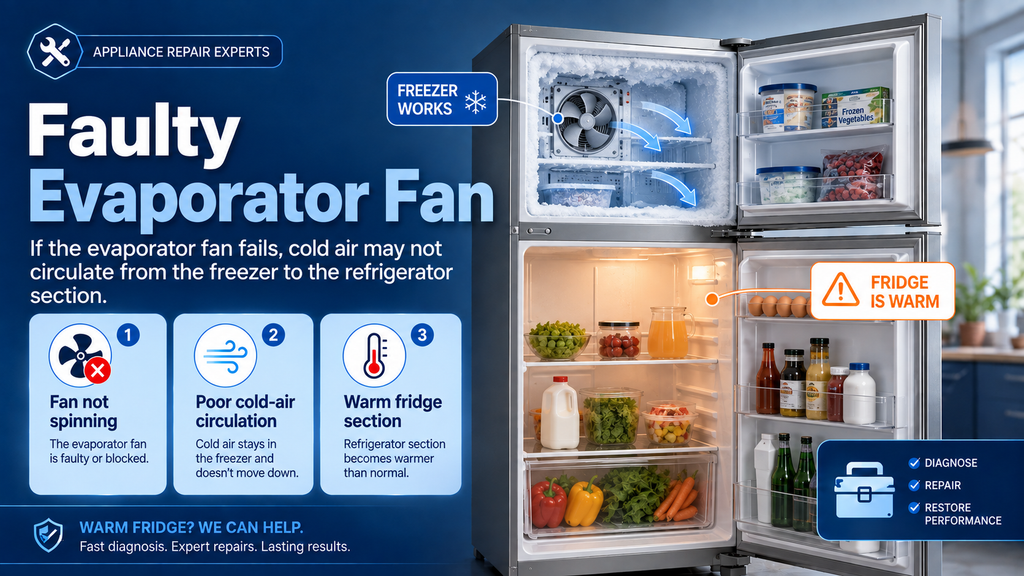
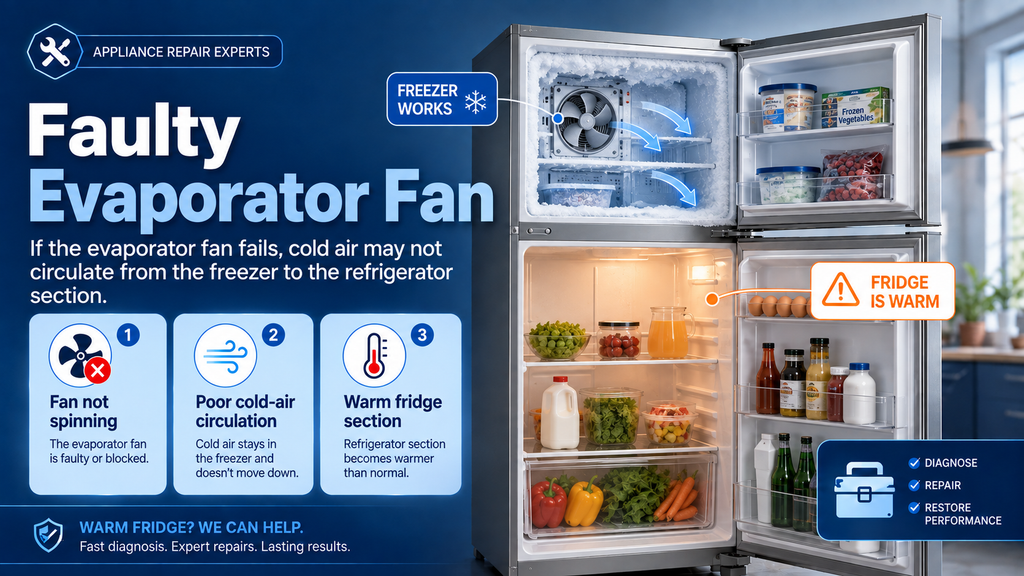
If the freezer is cold but the refrigerator compartment is warm, inspect airflow, evaporator fan operation, blocked vents, frost buildup, and temperature controls first.
If both the freezer and refrigerator are warm, the problem may involve condenser performance, compressor operation, starting components, refrigerant, controls, or the sealed refrigeration system.
Actual temperatures are much more useful than descriptions such as “the freezer feels cool.”
Measure both compartments with an appliance thermometer.
Check These Simple Problems Before Assuming a Part Has Failed
Before investigating the seven major causes, check several basic conditions.
Check the Temperature Setting
Make sure the refrigerator has not been accidentally set too warm.
Many refrigerators use approximately 37°F for the refrigerator and 0°F for the freezer as normal operating targets, although the correct setting depends on the manufacturer and model.
Make Sure Cooling Mode Is On
Some refrigerators can enter showroom, demo, or cooling-off modes. The lights and display may continue working while normal refrigeration stops.
Check the owner’s manual for your specific model if the refrigerator was recently installed, reset, moved, or experienced a power interruption.
Check the Air Vents
Do not pack food tightly against interior vents.
Whirlpool explains that cold air moves through supply and return vents and that blocked airflow can cause uneven temperatures, longer running times, and cooling problems.
Check the Door Gasket
Make sure containers, drawers, or shelves are not preventing the refrigerator door from closing.
Inspect the door gasket for dirt, damage, loose sections, or gaps that allow warm air to enter.
Check the Actual Temperature
A thermometer tells you whether you have a minor temperature variation or a genuine cooling failure.
If these basic checks do not explain the problem, move through the seven causes below.
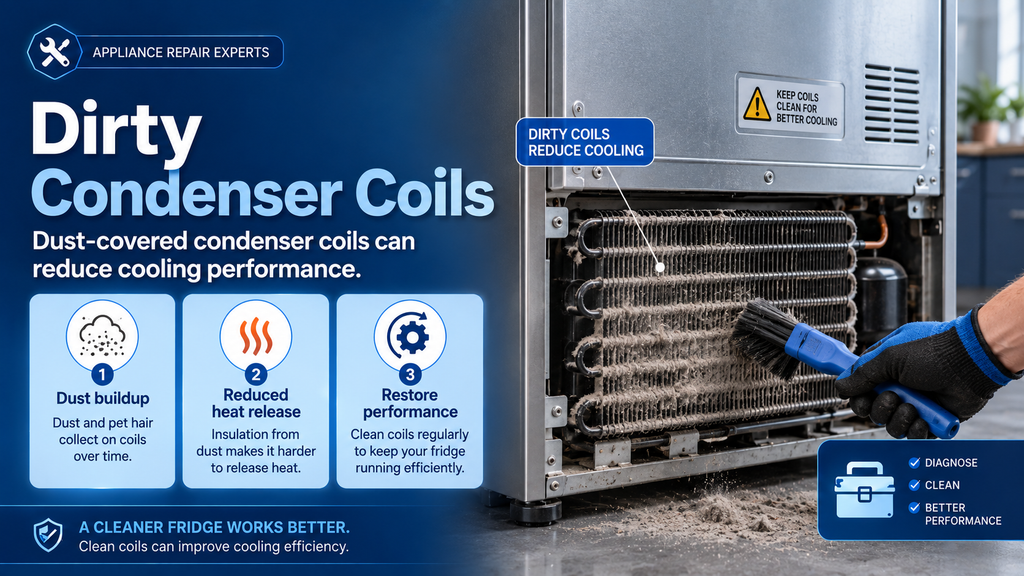
1. Dirty Condenser Coils Are Preventing Heat From Escaping
The condenser coils help release heat that the refrigerator removes from inside the cabinet.
Refrigeration depends on heat transfer. The evaporator absorbs heat from inside the refrigerator. The refrigerant carries that heat through the system, and the condenser releases it into the surrounding air.
When accessible condenser coils become heavily covered with dust, pet hair, grease, or debris, they may release heat less effectively. The compressor can then run longer while trying to reach the set temperature.
Whirlpool lists condenser condition among its checks for a refrigerator that is not cooling and notes that cleaning requirements vary by model and operating environment. Some models do not require routine homeowner cleaning.
Where Are the Condenser Coils?
Their location depends on the refrigerator design.
They may be:
• Behind the refrigerator
• Underneath the cabinet
• Behind the lower base grille or kick plate
• Inside a mechanical compartment that is not intended for routine homeowner access
Check your owner’s manual before removing panels.
What You Can Check
Disconnect power if the manufacturer requires access behind a grille or panel.
If the coils are designed for homeowner cleaning, remove loose dust with the method recommended by the manufacturer.
Do not bend refrigerant tubing or force tools into sealed areas.
If cleaning accessible coils improves cooling, restricted heat transfer may have contributed to the problem.
If the compressor still runs constantly and temperatures remain high, continue diagnosing.
2. The Condenser Fan or Evaporator Fan Is Not Working
A refrigerator may contain more than one cooling fan, and each performs a different job.
Understanding this difference can prevent unnecessary parts replacement.
What the Condenser Fan Does
The condenser fan motor moves air around the condenser and compressor compartment on models that use a fan-cooled condenser.
LG explains that a condenser fan fault can reduce heat dissipation, increase compressor workload, and raise internal refrigerator temperature.
If the compressor runs but the condenser fan should be operating and remains still, cooling performance can suffer.
Possible signs include:
• Little or no airflow near the condenser
• A silent condenser fan
• Fan blades blocked by debris
• Abnormal fan noise
• A warm mechanical compartment
• A refrigerator that runs for long periods without reaching temperature
What the Evaporator Fan Does
The evaporator fan moves air across the cold evaporator coils and circulates that air through the refrigerator.
On many single evaporator refrigerators, the evaporator sits in the freezer area, and the fan helps distribute cold air through both compartments.
If that fan stops, the freezer may remain colder near the evaporator while the refrigerator compartment warms.
iFixit specifically identifies failed condenser and evaporator fan motors as important causes when a refrigerator runs but does not cool correctly.
Listen Before Removing Anything
Some evaporator fans stop when the refrigerator or freezer door opens.
You may need to activate the door switch before deciding the fan has failed.
Listen for:
• Normal fan airflow
• Grinding
• Scraping
• Whirring that changes suddenly
• A fan blade striking ice
• Complete silence when the fan should be running
A fan that spins freely by hand can still have an electrical or control problem, so a visual inspection does not prove that the motor is good.
3. Frost Is Blocking the Evaporator Because of a Defrost Problem
A frost-free refrigerator still produces frost during normal operation. Its automatic defrost system periodically removes that frost before it restricts airflow.
Depending on the model, the defrost system may include:
defrost heater → defrost thermostat or sensor → thermistor → electronic control or defrost timer
If one part of that system fails, frost can gradually cover the evaporator coils.
As the ice becomes thicker, the evaporator fan struggles to move cold air through the coil.
Eventually, the compressor may continue running while cooling inside the refrigerator becomes weak.
One of the Best Clues Is the Freezer Back Wall
Look at the interior rear panel of the freezer.
Heavy frost, snow-like buildup, or solid ice behind or around that panel can indicate that the evaporator area is freezing over.
Do not use a knife or sharp object to remove ice.
Why Manual Defrosting Can Be Misleading
A complete thaw may temporarily restore airflow.
The refrigerator may begin cooling normally again because the ice obstruction has disappeared.
But if frost returns several days later, the thaw did not repair the underlying problem.
The actual fault could involve:
• Defrost heater
• Defrost thermostat
• Defrost sensor
• Thermistor
• Thermal fuse on applicable designs
• Defrost timer on applicable designs
• Electronic control board
LG explains that its refrigerators use automatic defrost operation and provides manual defrost procedures for significant frost buildup. Persistent frost or repeated error conditions can require professional diagnosis.
Pay Attention to the Frost Pattern
Do not only ask whether frost exists.
Ask what the frost looks like.
Heavy ice across the evaporator area can support a defrost or airflow diagnosis.
An unusual or limited frost pattern combined with poor cooling can justify deeper testing of the refrigeration system.
A frost pattern alone should not be used to declare that a refrigerator has a refrigerant leak.
4. The Thermostat or Thermistor Is Sending Incorrect Temperature Information
Modern refrigerators depend on temperature information to decide when cooling components should operate.
A thermistor is a temperature sensor whose electrical resistance changes as temperature changes.
The relationship works roughly like this:
Thermistor → temperature reading → control board → compressor and fan decisions → compartment temperature
If the thermistor reports incorrect information, the control system may make incorrect cooling decisions.
The refrigerator can therefore run too little, too much, or incorrectly even when the temperature setting looks normal.
iFixit notes that refrigerators may use several thermistors for the fresh food compartment, freezer compartment, and defrost functions.
Possible Clues
• Displayed temperature does not match the actual temperature
• Refrigerator runs continuously
• Refrigerator cycles at unusual times
• One compartment becomes much warmer than expected
• Error codes appear
• Fans and compressor appear functional but temperature remains incorrect
LG documents separate refrigerator temperature sensor and defrost sensor fault codes on applicable models, showing why sensor problems can affect cooling performance.
A technician can compare sensor resistance with the manufacturer’s temperature specifications.
Replacing a thermistor based only on symptoms is risky because airflow, fan, frost, sensor, and control problems can produce similar complaints.
5. The Compressor Is Not Starting or Running Correctly
The compressor pressurizes refrigerant and drives the refrigeration cycle.
However, one of the most common diagnostic mistakes is assuming that any hum from the back of the refrigerator proves the compressor is operating normally.
It does not.
Listen to the Pattern
A compressor that starts normally may produce a steady hum and some vibration.
A compressor that struggles to start may produce a different pattern.
For example:
Click → buzz or hum → click → silence → repeat
Repeated starting attempts can point toward a problem involving a compressor start relay, start capacitor, run capacitor, thermal overload, inverter system, compressor motor, or related electrical circuit.
Real appliance repair discussions also show why vibration and sound should be considered together rather than using sound alone. Homeowners commonly mistake fan noise for compressor operation or assume a warm compressor means it is pumping correctly.
Do Not Keep Forcing a Compressor That Repeatedly Fails to Start
Repeated clicking, overheating, electrical smells, or unusually loud humming deserves professional attention.
Compressor start circuits involve electrical components, and some capacitors can retain charge after power is removed.
This is no longer a basic homeowner inspection.
6. The Refrigerator Has a Refrigerant or Sealed System Problem
If the compressor and fans appear to operate but the refrigerator still cannot remove enough heat, the problem may involve the sealed system.
The sealed refrigeration system includes:
• Compressor
• Refrigerant
• Condenser
• Evaporator
• Refrigeration tubing
Depending on the failure, a refrigerator may have reduced cooling capacity even while the compressor continues operating.
Potential sealed system problems include:
• Refrigerant leak
• Refrigerant restriction
• Weak compressor pumping
• Abnormal refrigerant flow
• Damage within the sealed refrigeration circuit
iFixit lists refrigerant leaks and compressor problems among the later diagnostic possibilities when more accessible causes have been eliminated.
Refrigerant Work Is Not Normal DIY Refrigerator Repair
Do not attempt to open refrigeration tubing or add refrigerant simply because the refrigerator is warm.
A proper diagnosis may require pressure measurements, temperature measurements, leak detection, electrical testing, and evaluation of the evaporator frost pattern.
Sealed system repair also requires specialized equipment and appropriate refrigerant handling procedures.
At this stage, professional refrigerator repair is the better path.
Service King lists inadequate cooling, faulty thermostats and sensors, ice buildup, unusual noises, and refrigerator and freezer problems among its appliance repair services.
Service King refrigerator and freezer repair services
7. The Main Control Board or Compressor Inverter Board Has Failed
Modern refrigerators rely heavily on electronic controls.
The main control board may process temperature sensor information and control the compressor, fans, defrost operation, dampers, and other components.
Some variable speed compressors also use a compressor inverter board.
If an electronic control fails, the refrigerator may receive power and appear to run while one or more cooling components operate incorrectly.
Do Not Replace the Main Board First
Control boards can be expensive and are often difficult to diagnose from symptoms alone.
Before blaming a board, check the components it controls.
That can include:
• Evaporator fan
• Condenser fan
• Thermistors
• Defrost system
• Compressor operation
• Wiring connections
• Temperature settings
• Error codes
iFixit similarly recommends checking cooling fans, controls, and the defrost system before treating the main control board as the cause.
A technician can test whether the board receives correct sensor information and whether it sends the expected output to the affected component.
What Does Your Refrigerator Sound Like?
Sound can help narrow the problem when you combine it with temperature and airflow observations.
Steady Normal Hum but Poor Cooling
Check:
• Actual compartment temperatures
• Condenser cleanliness
• Condenser fan
• Evaporator fan
• Frost buildup
• Airflow
• Thermistors
• Sealed system performance
A steady hum means something is operating. It does not prove that the refrigerator is removing enough heat.
Repeated Clicking and Buzzing
Repeated compressor starting attempts may point toward:
• Start relay
• Capacitor
• Thermal overload
• Inverter board
• Compressor problem
Do not keep cycling power repeatedly if the compressor becomes extremely hot or continues making abnormal start sounds.
Grinding or Scraping From Inside the Freezer
Inspect for:
• Ice touching the evaporator fan blade
• Fan motor wear
• Physical obstruction
• Heavy frost buildup
No Evaporator Fan Sound
Possible causes include:
• Failed evaporator fan motor
• Ice obstruction
• Door switch condition
• Wiring issue
• Control problem
Remember that some fans stop when the door opens.
A Simple Symptom-Based Diagnostic Path
Use this sequence instead of randomly replacing parts.
Step 1
Measure the refrigerator and freezer temperatures.
Step 2
Confirm the temperature settings and make sure cooling mode is enabled.
Step 3
Determine whether both compartments are warm or only one.
Step 4
Listen separately for the compressor, condenser fan, and evaporator fan.
Step 5
Inspect accessible air vents and door seals.
Step 6
Look for heavy frost on the freezer rear panel.
Step 7
Inspect accessible condenser areas according to the owner’s manual.
Step 8
Pay attention to compressor sounds.
A steady operating sound and a repeated click-and-buzz pattern do not point toward the same diagnostic path.
Step 9
If airflow, fans, frost, settings, and basic maintenance do not explain the failure, move to sensor, electrical control, compressor, and sealed system testing.
This progression gives each observation a purpose.
What Can You Safely Check Yourself?
Homeowners can gather a surprising amount of useful information without dismantling the refrigerator.
You can usually:
• Measure refrigerator temperature
• Measure freezer temperature
• Confirm control settings
• Check whether cooling mode is enabled
• Clear blocked air vents
• Rearrange overcrowded food
• Check door closure
• Clean accessible gasket surfaces
• Listen for fans
• Listen to compressor behavior
• Look for frost on the freezer back panel
• Check the display for error codes
• Clean homeowner accessible condenser areas according to the manufacturer’s instructions
• Record the refrigerator model number
Service King also recommends basic checks such as confirming temperature settings, checking door sealing, and inspecting coil cleanliness before moving to professional refrigerator diagnosis.
safe appliance checks before calling a technician
What Should You Leave to an Appliance Technician?
Stop basic troubleshooting when diagnosis requires access to live electrical circuits, compressor components, or the sealed refrigeration system.
A technician may need to perform:
• Multimeter testing
• Thermistor resistance testing
• Defrost heater testing
• Defrost thermostat testing
• Fan voltage testing
• Compressor winding testing
• Capacitor testing
• Control board input and output testing
• Inverter diagnosis
• Evaporator frost pattern evaluation
• Refrigeration pressure diagnosis
• Refrigerant leak testing
• Sealed system repair
Testing these systems without the correct tools can create electrical hazards or damage the refrigerator.
When Should You Call for Refrigerator Repair?
Consider professional diagnosis when:
• The refrigerator stays above 40°F
• Both compartments remain warm
• The compressor repeatedly clicks or struggles to start
• The evaporator fan does not operate
• The condenser fan does not operate when expected
• Heavy frost returns after defrosting
• The appliance displays recurring error codes
• The compressor runs for long periods without reaching temperature
• Cooling returns temporarily and then fails again
• You suspect refrigerant loss
• Electrical components need testing
• The main control or inverter board may be involved
• Basic cleaning and airflow checks do not improve cooling
Service King provides appliance diagnosis and refrigerator repair for cooling problems in the Bridgeport area.
Service King appliance repair in Bridgeport CT
Is It Worth Repairing a Refrigerator That Runs but Does Not Cool?
That depends on the failed component and the condition of the appliance.
A fan motor, sensor, thermostat, door gasket, or defrost component can lead to a very different repair decision than a compressor or sealed system failure.
Consider:
• Refrigerator age
• Repair history
• Overall condition
• Failed component
• Parts availability
• Warranty coverage
• Repair estimate
• Replacement cost
• Energy efficiency
Do not replace a refrigerator simply because it runs without cooling.
First identify the failure.
Likewise, do not keep investing in random parts when the problem points toward an expensive compressor or sealed system repair.
An accurate diagnosis gives you the information needed to compare repair with replacement.
Refrigerator Running but Not Cooling in Bridgeport, CT?
If your refrigerator has power and appears to run but the food keeps getting warmer, the problem may involve much more than a temperature setting.
Service King LLC provides refrigerator and freezer diagnosis for cooling problems, unusual noises, ice buildup, thermostats, sensors, compressor concerns, and other appliance faults. The company also states that its technicians service major appliance brands.
A technician can follow the cooling system from the condenser and compressor through the evaporator, fans, defrost system, thermistors, controls, and sealed refrigeration system to determine why the refrigerator runs without reaching the correct temperature.
If your refrigerator is running but still not cooling properly, Service King LLC can help identify the cause before the problem leads to spoiled food or a more expensive repair. Our technicians can inspect the compressor, condenser coils, evaporator fan, defrost system, temperature sensors, control components, and overall cooling performance to find the actual fault. If basic troubleshooting has not restored safe temperatures, schedule professional refrigerator and freezer repair with Service King LLC for a clear diagnosis and repair recommendation..