
When your refrigerator is not cooling, but the freezer works, the problem often involves the way cold air reaches or stays inside the fresh food compartment. In many refrigerator designs, the freezer produces the cold air, and an evaporator fan, air ducts, air vents, and damper control help move and regulate that air inside the refrigerator.
Start with the simple checks before assuming the compressor or sealed refrigeration system has failed. Blocked vents, poor food placement, frost buildup, a weak evaporator fan, a stuck damper, an inaccurate thermistor, or a door that does not seal correctly can all leave the freezer cold while the refrigerator temperature rises.
If you are in Bridgeport and the basic checks below do not solve the problem, Service King LLC lists refrigerator cooling problems, ice buildup, thermostats, and sensors among the issues covered by its refrigerator and freezer repair service.
Refrigerator and freezer repair service
First, Check the Actual Refrigerator Temperature
Do not judge the refrigerator only by touching a shelf, bottle, or food container. Use an appliance thermometer to measure the actual temperature inside both compartments.
The FDA recommends keeping the refrigerator at 40°F or below and the freezer at 0°F. It also advises against packing refrigerated food so tightly that cold air cannot circulate it. If your refrigerator is above the safe range, protect perishable food while you diagnose the cooling problem.
FDA safe refrigerator temperature guidance
Many manufacturers use approximately 37°F for the refrigerator and 0°F for the freezer as normal settings. LG, for example, lists 37°F and 0°F as its recommended temperatures on relevant models and recommends allowing time for temperatures to stabilize after an adjustment.
LG refrigerator temperature guidance
A freezer that merely feels cold does not prove it is actually maintaining 0°F. Measuring both compartments helps separate an airflow problem from a broader loss of cooling capacity.
Why Can the Freezer Work While the Refrigerator Gets Warm?
Understanding how your refrigerator moves heat makes this symptom easier to diagnose.
In a typical single evaporator refrigerator, refrigerant passes through the evaporator coils, where the evaporator absorbs heat. An evaporator fan motor moves cold air through the freezer and toward the fresh food compartment through vents or an air duct. A damper may regulate how much air enters the refrigerator section.
The relationship is simple:
Freezer → evaporator coils → cold air → evaporator fan → air duct → damper → refrigerator compartment
If anything interrupts that path, the freezer can stay much colder than the refrigerator.
GE Appliances explains that on applicable designs, the freezer supplies cold air to both compartments and a damper controls how much of that air enters the fresh food section.
GE refrigerator damper and temperature controls
Single Evaporator and Dual Evaporator Refrigerators Behave Differently
Do not assume every refrigerator uses the same airflow layout.
A single evaporator refrigerator commonly shares cooling between the freezer and fresh food section. On these models, an evaporator fan, blocked vent, frost restriction, or closed damper deserves early attention.
A dual evaporator refrigerator can have a separate evaporator and airflow system for the refrigerator compartment. This means the freezer may operate normally while a fresh food evaporator, refrigerator fan, sensor, or frost problem affects only the refrigerator section.
GE documents both traditional single cooling designs and dual evaporator systems that cool the freezer and fresh food compartments separately.
This distinction matters on some French door refrigerators, side-by-side refrigerators, top freezer refrigerators, and bottom-freezer refrigerators. Always use the model number when moving beyond basic troubleshooting.
The Best Order for Diagnosing a Warm Refrigerator and Cold Freezer
Instead of replacing parts at random, follow this order:
- Measure refrigerator and freezer temperatures.
- Check temperature settings.
- Clear supply vents and return vents.
- Confirm that food is not restricting cold air circulation.
- Listen for the evaporator fan.
- Look for heavy frost or ice buildup.
- Check airflow through the damper.
- Inspect the refrigerator door and door gasket.
- Consider the thermistor and temperature sensor.
- Check the defrost system and electronic controls.
- Evaluate condenser cooling.
- Investigate the compressor or sealed system only when the earlier checks do not explain the symptom.
This progression follows the physical path that cooling takes through the appliance and helps narrow the problem without making an expensive guess.
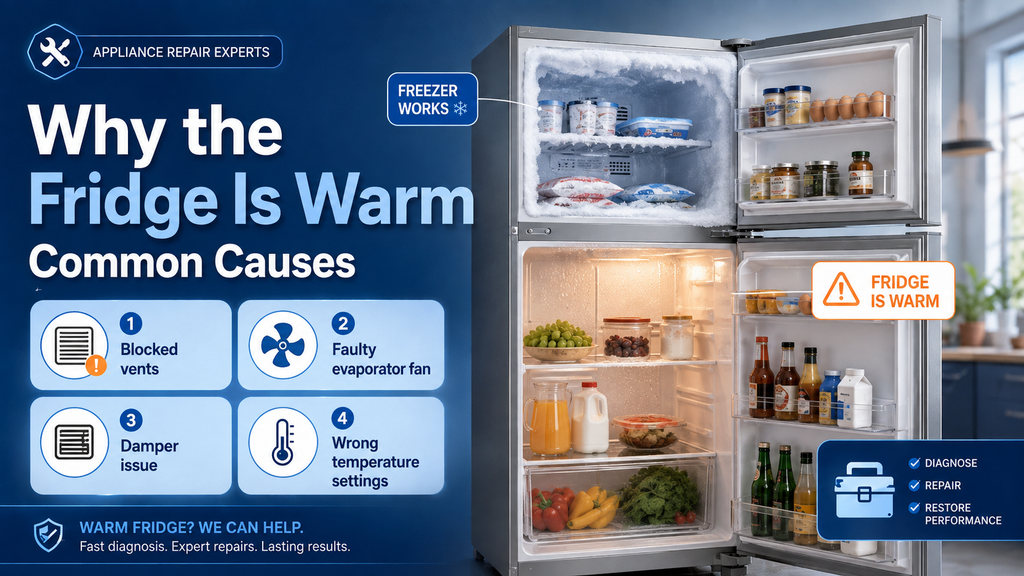
1. Blocked Air Vents May Keep Cold Air Out of the Refrigerator
Restricted airflow is one of the first things to check.
Boxes, containers, food bags, and crowded shelves can block a supply vent, return vent, or interior air passage. Cold air may remain concentrated around the freezer while the refrigerator compartment receives too little circulation.
Whirlpool explains that cold air enters and exits the refrigerator through vents connected with the freezer and warns that blocked vents can reduce airflow and create temperature and moisture problems.
Whirlpool proper refrigerator airflow guidance
What to Check
• Locate vents along the rear, upper, or side walls of the freezer and refrigerator.
• Move food containers away from vent openings.
• Avoid pressing large packages against the rear wall.
• Leave enough open space for cold air circulation between shelves.
• Check whether frost has formed directly over a vent.
• Make sure an overcrowded refrigerator is not preventing the door from closing fully.
After correcting food placement, allow the appliance time to stabilize and check it again with an appliance thermometer.
2. A Failed Evaporator Fan Can Leave the Refrigerator Warm
The evaporator fan is one of the most important components in this symptom pattern.
The evaporator coils absorb heat, but the cold air still has to move. The evaporator fan motor turns a fan blade that circulates air across the cooling coil and through the refrigerator.
When the fan stops, the freezer may remain cold near the evaporator while much less cold air reaches the fresh food compartment.
Signs of an Evaporator Fan Problem
• Very weak airflow from refrigerator vents
• No normal fan sound from the freezer area
• Grinding, scraping, or squealing
• A fan blade striking ice
• The freezer stays cold while the fresh food compartment becomes progressively warmer
• Cooling changes when the refrigerator door switch is pressed
Some refrigerator fans stop when a door opens. If you are only listening with the freezer door open, you may mistakenly think the fan has failed.
You can safely listen for the fan and look for obvious ice around it. Testing fan motor voltage, resistance, wiring, or control signals should generally be left to someone comfortable working with electrical appliances.
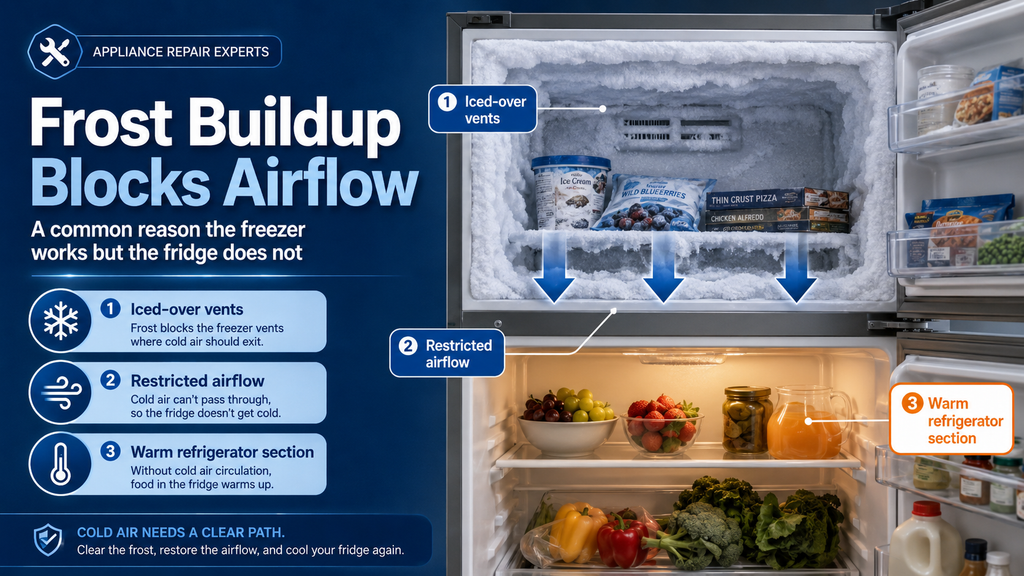
3. Frost Buildup Can Block the Evaporator and Airflow
A small amount of frost can occur during normal operation. A thick frost pattern, solid ice on the freezer back panel, or ice packed around air passages deserves closer attention.
An automatic defrost system prevents the evaporator from becoming buried in frost. Depending on the refrigerator, that system can involve a defrost heater, defrost thermostat, defrost sensor, thermistor, wiring, and an electronic control or main control board.
When part of the defrost system fails, frost may build across the evaporator coil until the fan can no longer move enough air through it.
Common Clues
• Heavy frost on the freezer back panel
• Ice near the evaporator cover
• Reduced airflow from refrigerator vents
• A fan blade rubbing against ice
• The refrigerator improves after a complete defrost
• The same cooling problem returns after several days
LG notes that frost around air vents can restrict cold air movement and reduce cooling efficiency. Its current support guidance also tells owners to make sure vents remain unobstructed after defrosting.
A complete manual defrost may temporarily restore airflow, but it does not repair a failed heater, sensor, thermostat, wiring connection, or control.
If heavy frost quickly returns, the cause needs further diagnosis.
4. A Stuck Damper Can Restrict Cold Air
The damper control regulates airflow between compartments on many refrigerator designs.
Think of it as an adjustable gate. When the fresh food compartment needs more cooling, the system can open the damper and allow additional cold air to enter.
If the damper stays closed because of ice, mechanical damage, a failed damper motor, sensor information, or an electronic control problem, the freezer may keep cooling while the refrigerator warms.
A Damper Problem Becomes More Likely When
• The evaporator fan appears to run normally
• The freezer is maintaining a proper temperature
• Supply vents are clear
• Heavy evaporator frost is not blocking airflow
• Very little cold air enters the refrigerator near the damper
• The damper remains closed when cooling demand should be high
Damper position and testing methods vary significantly by model. Use the exact model number before removing covers or ordering a replacement.
5. A Thermistor or Temperature Sensor May Report the Wrong Temperature
Modern refrigerators depend heavily on thermistors and other temperature sensors.
A thermistor changes electrical resistance as temperature changes. The electronic control uses that information to decide when to operate components such as the compressor, fan, and damper.
If a refrigerator thermistor reports an inaccurate temperature, the control board may believe the fresh food compartment is already cold even when the actual refrigerator temperature is too high.
The symptoms can resemble a bad fan or damper, which is why replacing a sensor based only on the symptom can waste money.
A technician can compare the thermistor reading with the actual compartment temperature and the manufacturer specifications.
6. Check the Refrigerator Door and Door Gasket
A refrigerator cannot maintain temperature efficiently when warm room air continually enters through the door.
Inspect the door gasket, sometimes called the door seal, around the entire refrigerator door.
Look For
• Food or grease on the gasket
• Torn or damaged gasket material
• Loose gasket sections
• A refrigerator door that does not close completely
• Containers or drawers preventing closure
• Condensation or moisture near the door
• Frost developing near a particular edge
A clean gasket should sit evenly against the refrigerator cabinet. Warm air intrusion adds heat and moisture, which can increase condensation and frost while making the refrigerator work harder.
LG identifies overloaded compartments, improperly positioned shelves, debris on the gasket, and loose gasket sections as possible causes of poor door closure.
7. Check Temperature Settings Before Replacing Parts
Someone may have changed a control accidentally, especially on refrigerators with an interior dial or an unlocked electronic control panel.
Verify both the refrigerator temperature setting and freezer temperature setting before continuing.
Do not immediately set the refrigerator to its coldest possible position. Start with the manufacturer-recommended setting and allow time for the appliance to stabilize.
If the display says 37°F while a separate appliance thermometer shows the refrigerator is much warmer, that difference becomes useful diagnostic information.
It may point toward poor airflow, an inaccurate sensor, a damper problem, or another component that prevents the system from reaching the requested temperature.
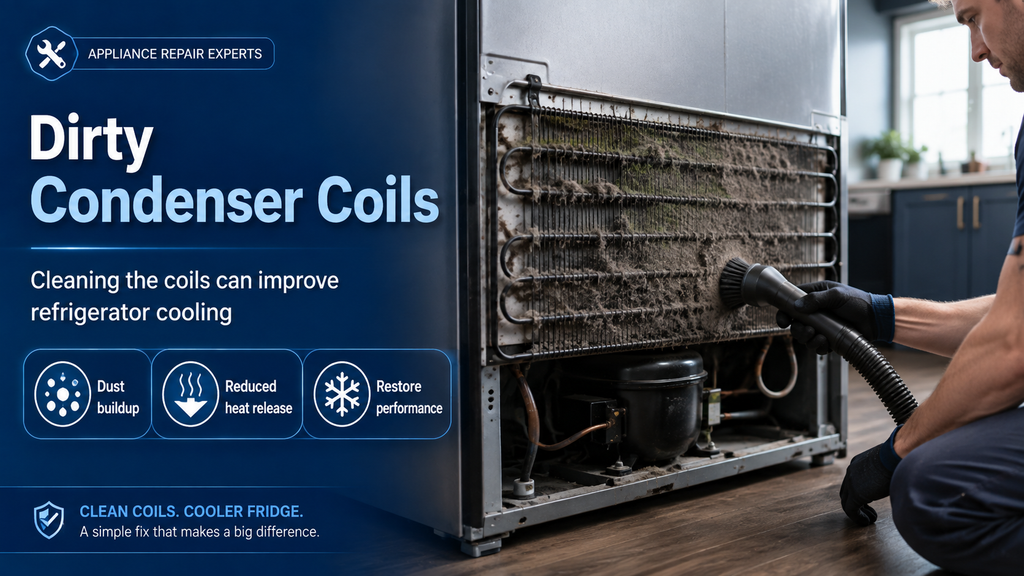
8. Dirty Condenser Coils Can Reduce Overall Cooling Capacity
The condenser releases heat that the refrigeration system removes from the compartments.
On models with accessible condenser coils, dust, pet hair, and debris can restrict heat transfer. A blocked condenser area or failed condenser fan motor can reduce overall cooling efficiency and increase compressor operating time.
For the specific symptom of a properly cold freezer and a warm refrigerator, condenser problems usually belong lower in the diagnostic order than airflow, fan, frost, or damper faults.
They still matter, particularly when both compartments are warmer than they should be or the compressor seems to run for unusually long periods.
Follow the manufacturer’s instructions for cleaning any homeowner accessible condenser area.
9. The Defrost System May Need Component Testing
If frost keeps returning after a complete defrost, a technician may need to test the defrost cycle.
Depending on the design, diagnosis can involve:
• Defrost heater continuity
• Defrost thermostat operation
• Defrost sensor readings
• Thermistor values
• Wiring connections
• Control board output
• Automatic defrost operation
The goal is not simply to remove the ice. The goal is to determine why the evaporator became excessively frosted in the first place.
10. The Main Control Board Can Cause Cooling Problems
The main control board or electronic control processes information from temperature sensors and controls components throughout the refrigerator.
A board problem can interfere with the evaporator fan, damper motor, compressor, defrost system, or other electrical components.
However, a control board should not be the first part replaced simply because no obvious mechanical problem appears.
A technician should first verify the inputs and components the board controls. Otherwise, a perfectly good control board may be replaced when the real problem is a sensor, fan motor, wiring connection, or frost restriction.
11. Could the Compressor or Sealed System Still Be the Problem?
Yes, although these problems should normally appear later in the diagnostic process when the freezer still works.
The sealed system includes the compressor, refrigerant tubing, evaporator, condenser, and related refrigeration components. Possible faults can include:
• Reduced compressor performance
• A refrigerant leak
• Refrigerant flow restriction
• Abnormal refrigerant pressure
• Reduced cooling capacity
A freezer that feels cold does not automatically prove the sealed system is healthy.
For example, part of the evaporator may still become cold even when the appliance lacks enough capacity to keep the entire freezer at 0°F and the refrigerator at a safe temperature.
A technician can use actual compartment temperatures, compressor operation, the evaporator frost pattern, electrical testing, and refrigeration system measurements to determine whether the problem extends beyond airflow.
How the Frost Pattern Helps With Diagnosis
The appearance of the evaporator can provide useful information when a trained technician accesses it.
A broad, even frost pattern can suggest that the evaporator is receiving cooling across much of its surface.
A coil completely buried in ice can point toward an airflow or defrost problem.
A limited or unusual frost pattern may justify investigating refrigeration system performance.
The frost pattern should be evaluated together with actual freezer temperature, fan operation, compressor behavior, and manufacturer specifications. It should not be used alone to diagnose a refrigerant leak or compressor failure.
What Can You Safely Check Yourself?
Most homeowners can perform several useful checks without dismantling the appliance.
Safe Basic Checks
• Measure refrigerator and freezer temperatures with an appliance thermometer.
• Confirm the temperature settings.
• Clear blocked air vents.
• Rearrange overcrowded shelves.
• Make sure food is not blocking the door.
• Clean the refrigerator door gasket.
• Check that the door closes completely.
• Listen for normal evaporator fan operation.
• Look for frost on the freezer back panel.
• Look for ice covering return vents.
• Check the refrigerator display for an error code.
• Clean accessible condenser areas according to the owner’s manual.
• Record the model number before searching for model-specific information.
These checks often tell you whether the problem involves cold air circulation, a sealing issue, frost restriction, or a component that needs professional testing.
For additional basic appliance safety checks, Service King also provides guidance on what homeowners can inspect before calling for service.
Emergency appliance repair checks
What Should a Refrigerator Technician Check?
When the simple checks do not explain the problem, a proper refrigerator diagnosis should narrow the fault systematically instead of replacing parts until something works.
A technician may:
- Measure actual fresh food and freezer temperatures.
- Compare those temperatures with the control settings.
- Inspect supply and return airflow.
- Listen to and test the evaporator fan motor.
- Inspect the fan blade for ice or obstruction.
- Examine the evaporator frost pattern.
- Check the damper and damper motor.
- Test the thermistor or temperature sensor against manufacturer specifications.
- Check the defrost heater, thermostat, sensor, or control.
- Inspect condenser coils and condenser fan operation.
- Retrieve relevant error codes.
- Test electrical components with a multimeter when appropriate.
- Verify control board inputs and outputs.
- Evaluate the compressor and sealed refrigeration system if the earlier tests do not identify the problem.
This process connects each symptom to a component and reduces unnecessary parts replacement.
Brand and Model Specific Diagnosis Matters
The same complaint can have different causes depending on the refrigerator design.
Samsung, LG, Whirlpool, GE Appliances, Frigidaire, Maytag, and Bosch use different airflow layouts, electronic controls, error codes, fan arrangements, dampers, and evaporator configurations across their product lines.
The refrigerator may be a French door refrigerator, side-by-side refrigerator, top-freezer refrigerator, or bottom-freezer refrigerator. It may use a single evaporator, a dual evaporator, or another cooling layout.
That is why the model number matters more than the brand name alone when diagnosing an internal component.
When Should You Call a Refrigerator Repair Technician?
Professional appliance repair makes sense when:
• The refrigerator remains above 40°F after basic checks
• The evaporator fan does not operate normally
• Heavy frost keeps returning
• Ice repeatedly blocks air vents
• The damper does not appear to deliver airflow
• Error codes return
• The appliance makes unusual grinding, buzzing, or mechanical noises
• Cooling returns after defrosting but fails again
• Both compartments begin warming
• Electrical testing is required
• A sensor or control board needs diagnosis
• You suspect a compressor, refrigerant, or sealed system problem
The closer the diagnosis gets to live electrical components or the sealed refrigeration system, the stronger the reason to stop basic homeowner troubleshooting.
Is the Refrigerator Worth Repairing?
A warm refrigerator compartment does not automatically mean you need a new appliance.
Consider:
• Refrigerator age
• Failed component
• Overall appliance condition
• Previous repair history
• Parts availability
• Repair estimate
• Replacement cost
• Whether the sealed system is involved
An evaporator fan, door gasket, damper, thermistor, or defrost component presents a very different repair decision from a major sealed system problem.
Get an accurate diagnosis first, then compare the repair estimate with the condition and expected usefulness of the refrigerator.
Refrigerator Not Cooling in Bridgeport, CT?
If your freezer remains cold while the refrigerator compartment keeps getting warmer, Service King LLC provides appliance repair for refrigerator cooling problems and lists refrigerator and freezer repair, ice buildup, thermostats, sensors, leaks, and unusual noises among its service areas. Its website also states that it works with major appliance brands and offers upfront estimates and prompt appointment options.
A proper diagnosis can determine whether the problem comes from airflow, the evaporator fan, frost buildup, the defrost system, damper control, thermistor, temperature sensor, control board, condenser, compressor, or sealed system.
Instead of guessing which part has failed, have the cooling system tested in a logical order.